Why Understanding LED Technology Matters for Your Skin
 How does LED work?
An LED (Light-Emitting Diode) works by passing an electric current through a semiconductor. As electrons move through this material, they release energy as photons—particles of light. The specific color of light depends on the semiconductor material used.
You might wonder what this has to do with skincare. The answer is everything. The same technology that revolutionized lighting has transformed how we treat skin concerns like aging and acne.
Unlike old bulbs that heat a filament, LEDs convert electricity directly into light through
electroluminescence. This process generates minimal heat, allowing them to last for decades and use up to 90% less energy.
For skincare, this is crucial. LED devices can safely deliver specific wavelengths of light to your skin without burning it. For example, red light stimulates collagen production, while blue light kills acne-causing bacteria. The precision is remarkable.
As Saloni Bhandari, founder of SA Blissful Spa, I've spent years studying and applying advanced skincare technologies, including understanding exactly
how does LED work to transform skin health from the cellular level up. My expertise in LED light therapy has helped countless clients achieve radiant, refreshed skin through science-backed treatments.
The Science of Light: How Does an LED Work?
If you've ever wondered
how does LED work, you're about to find something pretty amazing. Unlike old-fashioned light bulbs that heat a tiny wire until it glows, LEDs work through a far more efficient process. Let's break down what's happening inside these remarkable little devices.

The Building Blocks of an LED
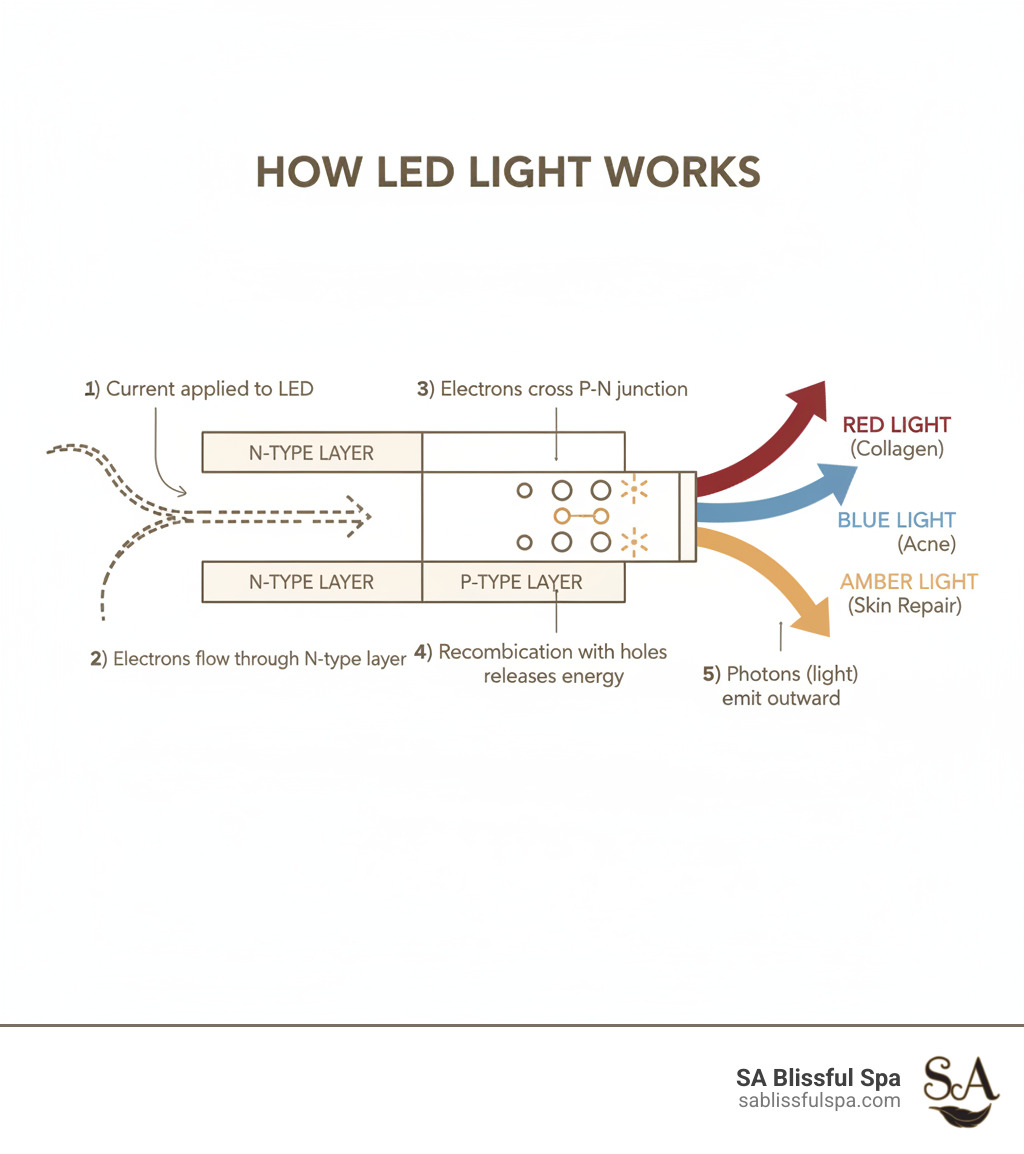
Every LED starts with a
semiconductor, a material that isn't quite a conductor or an insulator. Scientists "dope" this material by adding other elements to create two distinct layers.
The
N-type layer has a surplus of free electrons (negative charge). The
P-type layer has "holes," or spaces where electrons are missing (positive charge).
When these layers meet, they form a
P-N junction. This junction is where the action happens. The N-type layer connects to the
cathode (negative terminal), and the P-type layer connects to the
anode (positive terminal).

For skincare, LEDs use compound semiconductors like gallium nitride. While standard silicon diodes release energy as heat, these specialized materials release it as light. The specific material determines the light's color, which is crucial for targeting skin concerns.
The Magic of Electroluminescence
The process that makes an LED glow is called
electroluminescence—creating light directly from electricity. When you apply voltage in a
forward bias (positive to anode, negative to cathode), it pushes electrons from the N-type layer across the junction into the P-type layer.
There, the electrons "fall" into the empty holes. This
electron-hole recombination releases energy. Instead of becoming heat, this energy is emitted as a
photon—a particle of light. The amount of energy released determines the light's color. A larger energy drop creates higher-energy light (like blue), while a smaller drop creates lower-energy light (like red).
This direct conversion is why LEDs are so efficient and perfect for skin therapy, delivering precise wavelengths without damaging heat. You can learn more about the science behind this process through
scientific research on electroluminescence.
If you connect the electricity backward (
reverse bias), the electrons and holes are pulled away from the junction, no current flows, and no light is produced. This is why LEDs only work in one direction. This dance of electrons and holes is the heart of understanding
how does LED work.
From Physics to Facials: How LED Color Affects Your Skin
Understanding
how does LED work gets even more interesting when we connect it to skincare. The semiconductor materials inside an LED create very specific colors, or wavelengths, measured in nanometers (nm). Each wavelength provides a different skin benefit.

Decoding the LED Rainbow for Skincare
An LED therapy device is a carefully designed toolkit for your skin. Each color has a job to do.
Red light therapy (630-700nm) travels deep into the skin to stimulate fibroblasts, the cells that produce collagen and elastin. This results in firmer skin, fewer fine lines, and reduced wrinkles. Red light also improves circulation and calms inflammation.
Blue light therapy (400-470nm) is the acne-fighting champion. It specifically targets and destroys acne-causing bacteria while its anti-inflammatory properties help calm red, irritated skin.
Amber light therapy (570-620nm) is the gentle soother, ideal for sensitive skin. This wavelength reduces redness, calms irritation, and promotes lymphatic drainage to help your skin detoxify.
Green light therapy (495-570nm) addresses uneven skin tone and hyperpigmentation. It helps balance melanin production to gradually even out your complexion and reduce sun spots.
At SA Blissful Spa, we've watched clients from Burlington, Woburn, Lexington, and Arlington experience real changes with these different light wavelengths. The science is impressive, but the results speak even louder.
How does LED work for anti-aging and acne?
The cellular magic happening during LED therapy is remarkable. For
anti-aging, red light penetrates the skin and is absorbed by mitochondria, the powerhouses of your cells. This stimulates them to produce more ATP (cellular energy). With more energy, skin cells can synthesize more collagen and elastin, making skin firmer and more elastic. Circulation also improves, delivering more oxygen and nutrients to the cells.
For
acne, the mechanism is different. The
P. acnes bacteria in your pores produce light-sensitive compounds called porphyrins. When blue LED light hits them, it creates a chemical reaction that produces a form of oxygen toxic to the bacteria. Essentially, blue light causes the bacteria to self-destruct, leaving healthy skin cells unharmed, while also calming the associated redness and swelling.
This precise, cellular-level action is what makes LED therapy so effective. To find how we customize LED treatments for your unique skin needs, explore our advanced
facials and
peels at SA Blissful Spa.
LED vs. Traditional Lighting: A Bright Comparison
Understanding
how does LED work becomes even more impressive when you compare it to old lighting methods. The difference isn't subtle—it's transformative. The hot surface of an incandescent bulb is a sign of wasted energy, which is exactly what LEDs were designed to fix.
Efficiency and Heat: Why LEDs Shine Brighter
Incandescent bulbs waste about 90% of their energy as heat. You're paying to heat a room, not just light it. LEDs flip this equation. Because they work through electroluminescence, they are up to
90% more efficiently than incandescent bulbs. A 10-watt LED can deliver the same brightness as a 60-watt incandescent, using far less electricity.
This efficiency is measured in
luminous efficacy—how much light you get per watt. LEDs excel by converting electricity directly into photons with minimal heat loss. This is why LED therapy devices can be placed on your face for 20 minutes without burning you, while still delivering powerful wavelengths deep into your skin. For homeowners in Burlington, Woburn, or Lexington, this translates to lower electricity bills. For us at SA Blissful Spa, it means powerful, safe treatments. For more detailed insights into LED efficiency, you can explore
this helpful comparison.
Longevity and Durability
The longevity of LEDs is just as impressive. An incandescent bulb lasts about 1,000-2,000 hours, and a CFL lasts 10,000-15,000 hours. In contrast, an LED can last up to
50,000 hours. For our facial devices, this means consistent, reliable performance.
LEDs are also more durable. As
solid-state lighting, they have no fragile filament or glass to break, making them shock and vibration resistant. This ruggedness is perfect for both industrial applications and handheld skincare devices. Furthermore, unlike CFLs which contain toxic mercury, LEDs are
mercury-free and made from non-toxic materials, making them safer for you and the planet.
The Brilliant Benefits and Applications of LED Technology
Once you understand
how does LED work, you start to see this remarkable technology everywhere, from the screen you're reading this on to the streetlights outside.

Key Advantages of LED Technology
The unique way LEDs work provides numerous advantages. They offer huge
energy savings, using up to 90% less power than incandescent bulbs. Their
long operational life (up to 50,000 hours) means you may never have to change a bulb again. Other key benefits include:
- Compact size: Allows for integration into tiny spaces and flexible designs.
- Fast switching & Dimmability: They turn on instantly and allow for precise brightness control.
- Durability: As solid-state devices, they are rugged and resistant to shock.
- Safety: They are non-toxic, mercury-free, and operate at a low voltage.
- Monochromatic Light: Their ability to produce pure, single-wavelength colors without filters is what makes them so effective for skincare.
How does LED work in everyday life and skincare?
LEDs are woven seamlessly into modern life. They are used for
general illumination in homes and cities like Burlington, in
digital displays on your phone and TV, and in
automotive lighting. They have also revolutionized
horticulture with grow lights and are used in many
medical applications, such as pulse oximeters.
Of course, the most exciting application for us is
skincare and beauty. At SA Blissful Spa, our professional
LED Light Therapy treatments harness these precise wavelengths to stimulate collagen, reduce acne, and address various skin concerns. While at-home devices are popular, professional-grade equipment offers superior power and precision for more dramatic results.
The same fundamental principle—electrons emitting photons—powers everything from a tiny indicator light to sophisticated medical treatments. Whether illuminating a room or rejuvenating your skin, it all comes back to the brilliant light created by LEDs.
Frequently Asked Questions about LED Technology
You've learned the science behind
how does LED work, but we know you might still have questions, especially about using this technology on your skin. Let's address the concerns we hear most often at SA Blissful Spa.
Is LED light therapy safe for my skin and eyes?
Yes, LED light therapy is incredibly safe when performed correctly. Unlike sunlight, LEDs emit
specific wavelengths of light and do not contain harmful
UV radiation. This means there is no risk of sun damage or skin cancer. Because they produce very little heat, there is also
no thermal damage or risk of burns.
While the light is safe for skin, it can be bright for your eyes. That's why we always provide
eye protection during treatments at our Burlington spa to ensure your comfort. We use
FDA-cleared devices, which have met rigorous safety and efficacy standards. The
wavelength specificity of these devices ensures that each color of light performs its job without affecting other tissues.
How is white LED light created?
Individual LEDs produce only a single color. To create white light for household bulbs, manufacturers typically use one of two methods. The most common is coating a
blue LED chip with yellow phosphor; the mix of blue and yellow light appears white to our eyes. The other method is the
RGB method, which combines separate
red, green, and blue LEDs. By adjusting the intensity of each, any color, including white, can be created. This is why you can't use a household white light bulb for skin therapy—it lacks the specific, concentrated wavelengths needed for therapeutic results.
Can any LED light be used for skin therapy?
Absolutely not. There is a world of difference between a household bulb and a professional LED therapy device. Therapeutic devices are special for three reasons:
- Specific Wavelengths: They deliver precise wavelengths (e.g., 630-700nm for red light) that are calibrated to trigger specific cellular responses. A household bulb emits a broad, unfocused spectrum of light.
- Power Output (Irradiance): Professional devices deliver a sufficient intensity of light (measured in mW/cm²) to penetrate the skin and be effective. Many at-home devices have lower power, requiring more frequent or longer sessions for minimal results.
- Professional Guidance: At SA Blissful Spa, our trained estheticians understand how does LED work for different skin types. We use clinical-grade devices and can recommend the right wavelength combinations for your specific concerns.
While at-home devices can be useful for maintenance, there is no substitute for the precision and power of professional LED light therapy for serious results.
Conclusion: Illuminate Your Skin's Potential
We've traveled together through the remarkable science of
how does LED work, exploring the neat dance of electrons and holes within semiconductors, witnessing the magic of electroluminescence, and finding how this brilliant technology transforms electrical energy directly into healing light. It's a journey from physics labs to facial treatments, and honestly, it never stops amazing me.
What makes LED technology so special isn't just its efficiency or longevity, though those qualities have revolutionized lighting worldwide. For skincare, the real beauty lies in precision. LEDs can deliver exact wavelengths of light—whether red for collagen production, blue for acne bacteria, or amber for calming—without generating harmful heat or UV radiation. This targeted approach means your skin receives exactly what it needs, nothing more, nothing less.
At SA Blissful Spa, we've witnessed how this safe and effective technology transforms skin health. I've seen clients from Burlington, Belmont, and beyond experience renewed confidence as red light smooths fine lines, blue light clears stubborn breakouts, and their skin simply
glows with renewed vitality. Understanding the science behind these results—the mitochondrial stimulation, the ATP production, the bacterial destruction—helps us provide even better, more customized treatments for each unique complexion.
The future of lighting continues to evolve, and so does the future of skincare. As LED technology advances, we remain dedicated to bringing you the most innovative, luxurious, and results-driven treatments available. Your skin's potential is waiting to be illuminated, and we'd be honored to guide you there.
Ready to experience the radiant change for yourself?
Explore our advanced LED facial treatments and find how targeted light therapy can revitalize your complexion from the cellular level up. We also invite you to learn about our other specialized services, including
chemical peels and
oncology-safe skincare options.
Whether you're joining us from Winchester, Stoneham, Woburn, or anywhere in the Burlington area, we're here to help you achieve that blissful, healthy glow. Have questions? Want to book a consultation? Please
contact us—we'd love to hear from you.