Sugaring hair removal is an ancient, all-natural method that uses a simple paste of sugar, lemon juice, and water to pull hair out from the root — and in June 2026, it’s having a major moment as more women look for gentler alternatives to traditional waxing.
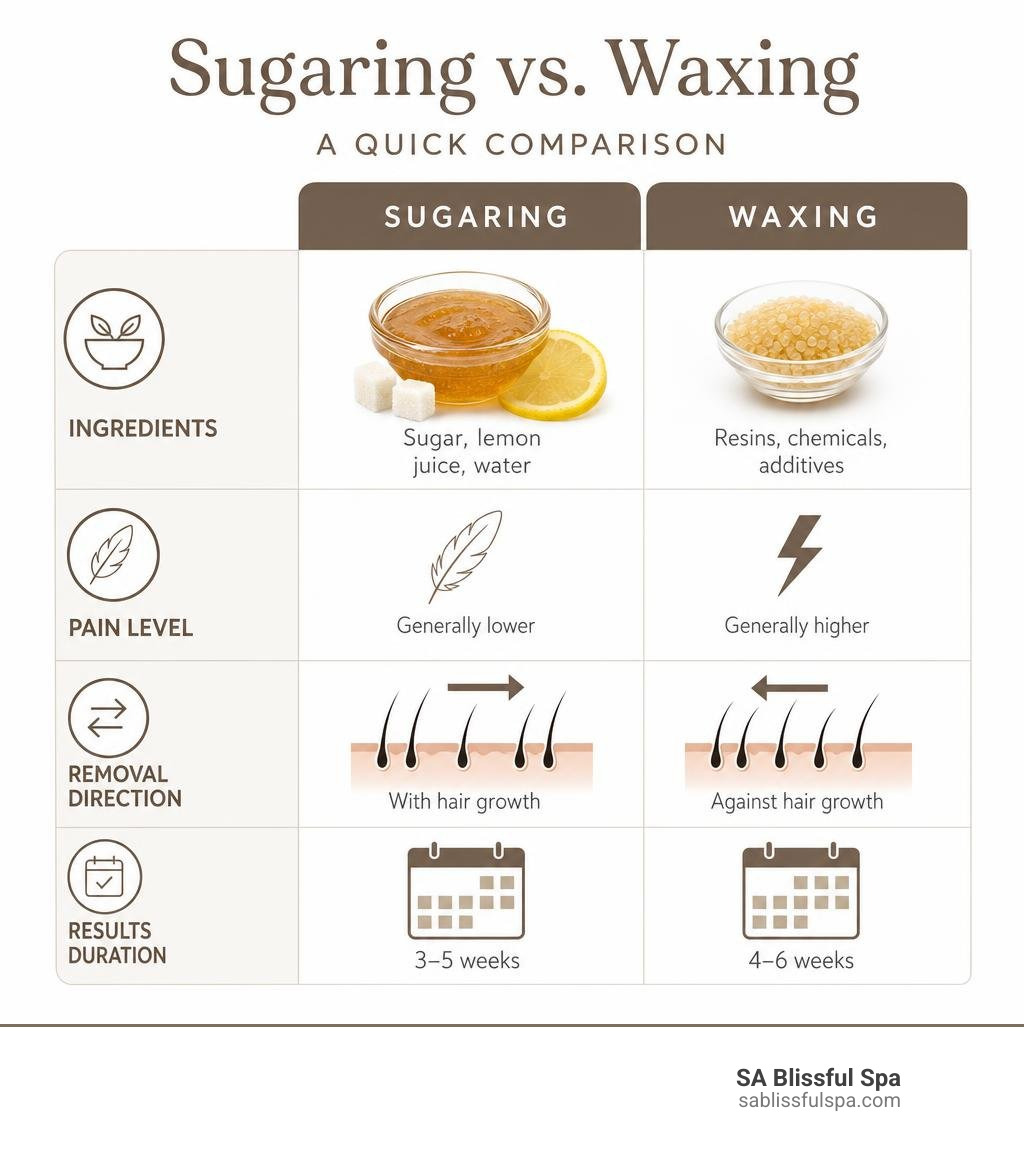
Here’s a quick look at how the two methods compare:
| Feature | Sugaring | Waxing |
|---|---|---|
| Ingredients | Sugar, lemon juice, water | Resins, chemicals, additives |
| Sticks to skin? | No — hair and dead skin only | Yes — live skin cells too |
| Removal direction | With hair growth | Against hair growth |
| Pain level | Generally lower | Generally higher |
| Cleanup | Warm water | Requires oil or solvent |
| Results last | 3–5 weeks | 4–6 weeks |
| Eco-friendly? | Yes — biodegradable | Usually not |
The short answer: sugaring tends to be less painful and more skin-friendly than waxing, but both methods remove hair from the root and deliver similar lasting results.
If you want the full picture — including how to prepare, what to avoid, and whether it’s right for your skin — keep reading.
Tired of the razor-burn cycle that comes back every few days? You’re not alone. More and more women are ditching the blade in favor of longer-lasting options. And while laser hair removal sits at one end of the spectrum, sugaring sits right in the sweet spot — less painful than waxing, more lasting than shaving, and made from ingredients you could find in your kitchen.
The technique itself isn’t new. It dates back to ancient Egypt and Persia, where it was used as far back as 1900 BC. But its simplicity and skin-friendly formula are exactly why it’s gaining so much renewed attention today.
I’m Saloni Bhandari, a licensed esthetician and founder of SA Blissful Spa in Burlington, MA, and sugaring hair removal is one of the treatments I’m most passionate about recommending to clients with sensitive skin. With years of hands-on experience in advanced skin care and hair removal techniques, I’ll walk you through everything you need to know to decide if sugaring is right for you.
To understand why this method has survived for thousands of years, we have to look at what it actually is. At its core, sugaring hair removal is a form of epilation. Unlike depilation (which only cuts the hair at the surface of the skin, like shaving), epilation removes the entire hair follicle from its root beneath the skin.
The magic lies in the sugaring paste itself. This thick, gel-like substance is made from just three simple, natural ingredients: sugar, lemon juice, and water. When heated and simmered to a precise temperature, these ingredients create a sticky, candy-like paste that behaves quite differently than cosmetic wax.
During a professional session, an esthetician molds this lukewarm paste onto your skin. Because of its unique physical properties, the paste wraps around each individual hair shaft and seeps slightly into the hair follicle. When the paste is flicked away, it lifts the hair directly from the root.
This method is far from a modern trend. The historical origins of sugaring) date back to ancient civilizations in Mesopotamia, Egypt, and Greece. In these ancient cultures, smooth, hairless skin was considered the standard of beauty and hygiene.
According to historical records, women in the Middle East and the Mediterranean used a honey-based or sugar-based paste to remove body hair. In Egypt, slave girls and royalty alike used this natural method. Across different cultures and eras, the practice has been known by several names, including sukkar or halawa in Arabic-speaking regions, agda in Turkey, and moum in Iran. Over time, as sugar production spread from Persia to the rest of the world, sugar replaced honey as the primary base for this highly effective paste.
What makes sugar, lemon juice, and water such a powerhouse trio? It all comes down to chemistry.
When white granulated sugar is heated with water and lemon juice (which acts as an acid), the sucrose breaks down into glucose and fructose. This process, known as sugar inversion, creates a highly pliable, sticky paste that is completely water-soluble.
Because the paste is water-soluble, it cannot bond to the water-rich live cells of your skin. It only adheres to the dry, dead skin cells on the surface and the keratinized hair shafts.
According to Dermatologist insights on sugaring, this selective adhesion is the primary reason why sugaring is so much gentler on the skin barrier. It acts as a mild exfoliant while leaving the underlying live skin completely intact, making it an excellent choice for those with reactive skin. For a deeper look into why this makes sugaring a premier option for delicate skin types, you can read More on sugaring for sensitive skin.
When deciding between these two popular hair removal methods, it helps to understand how they differ in application, comfort, cost, and overall efficiency. While both leave you smooth for weeks, they take very different paths to get there.
The single most important technical difference between sugaring and traditional waxing is the direction of application and removal.
With traditional waxing, the wax is applied in the direction of hair growth and ripped off against the direction of growth. This pulling motion against the natural growth pattern can put a massive amount of strain on the hair follicle, often causing the hair shaft to snap off at or just below the skin surface instead of sliding out cleanly. Broken hairs lead to faster regrowth and a higher risk of painful ingrown hairs.

In contrast, the traditional ball method of sugaring reverses this process. The esthetician molds the lukewarm sugar paste onto the skin against the direction of hair growth, allowing the paste to wrap around the hair and seep into the follicle. The paste is then flicked off in the natural direction of hair growth. This drastically reduces hair breakage and keeps the hair follicle intact, resulting in a cleaner extraction and smoother skin for a longer period.
Let’s address the question everyone asks: Does it hurt?
Since both methods pull hair out from the root, neither is completely painless. However, most people find sugaring to be significantly less painful than waxing.
Traditional wax (especially soft wax) is formulated to adhere to whatever it touches. When applied to your body, it grips both the hair and the live skin cells. When the wax strip is pulled away, it essentially peels off the top layer of live skin along with the hair, which causes that classic stinging pain and lingering redness.
Sugaring paste, on the other hand, only clings to the hair and dead skin. It will not stick to live skin cells. This means you experience far less trauma to the skin barrier. While you will still feel the quick snap of the hair being pulled from the follicle, the post-treatment stinging is almost non-existent. If you want to learn more about traditional waxing techniques to see how they compare, check out our Guide to waxing services.
When planning your beauty budget, it is helpful to look at how much you will spend and how often you will need to schedule appointments.
On average, sugaring results typically last around three to five weeks depending on the area treated and the rate at which your hair grows. Over time, consistent sugaring can damage the hair follicle, causing hair to grow back sparser, finer, and softer.
To give you a realistic idea of what to expect, we have compiled a cost comparison.
Please note: The prices listed below are average estimated costs based on broad internet data and do not represent the actual service costs at SA Blissful Spa.
Because sugaring requires specialized training and is less widely available than waxing, it often carries a slightly higher price tag. Depending on the body part and the salon, prices can range from $15 for a quick chin or lip treatment to $399 for a luxury full-body package. This wide range reflects the varying complexity of the treated areas.
| Treatment Area | Average Sugaring Cost Range (Internet Data)* | Average Waxing Cost Range (Internet Data)* | Typical Duration |
|---|---|---|---|
| Upper Lip / Chin | $15 – $45 | $10 – $30 | 10 mins |
| Underarms | $40 – $120 | $25 – $75 | 20 mins |
| Bikini / Brazilian | $55 – $240 | $40 – $150 | 25 mins |
| Full Legs | $120 – $360 | $70 – $210 | 45 mins |
Disclaimer: These are average costs based on internet data and are not actual costs for SA Blissful Spa.
If you are looking for highly professional, tailored hair removal options in the Burlington area, we invite you to explore our professional Waxing Services Near Me and find the Best Waxing Near Me to keep your skin glowing and smooth.
Beyond the lower pain levels, choosing a sugar-based paste offers incredible long-term benefits for your skin health, your wallet, and the planet.
In an era where we are all trying to be more mindful of what we put on our bodies, sugaring is a breath of fresh air. The paste is 100% organic, biodegradable, and eco-friendly. Unlike many commercial waxes that contain synthetic resins, parabens, artificial fragrances, and petroleum-based chemicals, sugar paste is completely chemical-free.
According to research on the Environmental benefits of sugar wax, because the paste is made solely of sugar, lemon, and water, it is fully hypoallergenic. It is so natural that it is technically edible! If you struggle with chemical sensitivities or want to reduce your environmental footprint, sugaring is the ultimate “clean beauty” hair removal choice.
Every sugaring session doubles as a nourishing skincare treatment. As the sugar paste is applied and removed, it gently lifts away the buildup of dead skin cells on the surface of your skin.
This natural exfoliation leaves your skin feeling incredibly soft and smooth. Even better, because sugaring removes the hair in its natural direction of growth without breaking the shafts, it drastically reduces the occurrence of ingrown hairs. If you are prone to those pesky, painful bumps in sensitive areas, switching to sugaring can be a total game-changer. For a detailed look at how this works for delicate areas, check out our Brazilian sugaring guide.
While sugaring is incredibly gentle, it is still an active physical treatment. Understanding the potential side effects and contraindications is key to keeping your skin safe and happy.
For most people, side effects are minimal and disappear within a few hours. The most common reaction is temporary redness and mild irritation, which is simply a natural response to having hair pulled from the roots.
Some individuals with highly sensitive skin might experience a minor histamine reaction, which looks like small, itchy white bumps. This is completely normal and typically subsides within 24 hours. In rare cases, poor technique (such as failing to hold the skin taut) can cause mild bruising or folliculitis (inflammation of the hair follicles).
Sugaring is not suitable for everyone. You should avoid sugaring if you are currently taking or using any of the following:
To get the absolute best results from your hair removal session—whether at home or in a professional spa—proper preparation and aftercare are essential.
If you are feeling adventurous and want to try this ancient art in your own kitchen, preparation is key.
First, ensure your hair is at the correct length—ideally between 1/8 and 1/4 inch long (about the length of a grain of rice). If it’s too short, the paste won’t grip; if it’s too long, the pulling can be uncomfortable.
Combine the ingredients in a heavy saucepan over medium-high heat. Bring the mixture to a gentle boil, stirring constantly. Once it begins to boil, reduce the heat to a low simmer. Watch the color closely: it will transition from a light yellow to a warm, honey-gold amber. This usually takes about 8 to 10 minutes.
To test the consistency, drop a small spoonful into a glass of cold water. If it forms a soft, malleable ball that doesn’t dissolve, it’s ready. Let it cool completely to room temperature before handling—molten sugar can cause severe burns!

For a complete, comprehensive walk-through, you can check out this detailed At-home sugaring guide.
What you do after your session is just as important as the treatment itself. For the first 24 to 48 hours after sugaring, your hair follicles are open and vulnerable to bacteria.
For more professional tips on maintaining smooth skin and preventing irritation, read our Complete guide to waxing and aftercare.
On average, your skin will remain beautifully smooth for three to five weeks. Because sugaring extracts hair from the root, regrowth is much slower and softer than shaving. Over time, as you stay consistent with your appointments, you will notice that your hair grows back significantly thinner and sparser.
Yes! In fact, sugaring is highly recommended for sensitive areas like the bikini line and Brazilian treatments. Because the paste only adheres to the hair and dead skin cells, it is incredibly gentle on the delicate, thin skin of the pubic region. It minimizes the redness, bumps, and ingrown hairs that often follow a traditional shave or wax. To explore more about intimate hair removal options, read about our Brazilian wax options.
Absolutely. Sugaring is fantastic for facial hair removal, including the upper lip, chin, eyebrows, and sides of the face (peach fuzz). Because the skin on the face is delicate and highly visible, the gentle, non-damaging nature of sugar paste makes it the perfect alternative to harsh facial waxes.
Whether you are looking to simplify your beauty routine, soothe sensitive skin, or transition to a more natural, eco-friendly lifestyle, sugaring hair removal is a time-tested method that delivers exceptional results.
At SA Blissful Spa in Burlington, MA, our team of highly trained, professional estheticians is dedicated to providing personalized, luxurious care in a serene and relaxing environment. We proudly serve clients throughout our local Massachusetts communities, including Arlington, Billerica, Lexington, Woburn, Winchester, and surrounding towns.
Ready to experience the ultimate in skin health and long-lasting smoothness? Book your next waxing or sugaring service with us today, and let us help you put your best, smoothest skin forward!


Book your first appointment online and enjoy 15% off your first service (one-time offer).
Use code NEWCLIENT15