Microchanneling vs microneedling cost is one of the first things clients ask about when considering a skin rejuvenation treatment. To give you a quick snapshot:
Price isn’t the only difference between these two procedures. But to understand what drives these cost variations, it’s important to see beyond the numbers and into the techniques and outcomes.
I’m Saloni Bhandari, founder of SA Blissful Spa and an experienced esthetician. Having performed numerous skin rejuvenation treatments over the years, I’ve advised many clients on microchanneling vs microneedling cost to help them make informed skincare decisions.

Basic microchanneling vs microneedling cost glossary:
– difference between microchanneling and microneedling
– microchanneling vs microneedling before and after
Before we explore deeper into microchanneling vs microneedling cost, let’s first understand what these treatments actually involve. Both of these popular skincare techniques fall under a family known as collagen induction therapy (CIT). CIT has transformed the skincare world since the mid-1990s, making youthful, glowing skin achievable without surgery or extensive downtime.
At their core, microchanneling and microneedling are minimally invasive treatments designed to trigger your body’s natural healing response. They do this by creating controlled micro-injuries in the skin. Don’t worry—it sounds scarier than it is! These tiny injuries are so small you can’t even see them with your naked eye, yet they’re powerful enough to signal your skin to ramp up collagen and elastin production.
Collagen and elastin are the vital proteins that keep skin firm, smooth, and youthful. Unfortunately, as we age, our bodies produce less of these proteins. In fact, by the time you’re in your 40s, you’ve likely lost around 20% of your collagen-producing capability. (We know—aging can be tough!) That’s precisely why collagen-stimulating treatments become increasingly popular among clients in their 30s and beyond.
Both microneedling and microchanneling are effective at addressing a range of common skin concerns, including fine lines and wrinkles, acne scars and surgical scars, uneven skin texture, hyperpigmentation, enlarged pores, stretch marks, and reduced skin elasticity. By encouraging cell turnover and enhancing your skin’s ability to absorb beneficial serums, these procedures help you achieve smoother, healthier-looking skin. If you’re curious about more differences between these two rejuvenating treatments, you can explore our detailed comparison here.
The magic behind collagen induction therapy is pretty fascinating. When tiny needles gently penetrate your skin’s upper layers, they create microscopic, controlled “injuries.” Your body immediately jumps into action, initiating a natural wound healing process. This healing process unfolds in three main stages:
First comes the inflammation stage, where your body increases blood flow and rushes in nutrients and growth factors to begin repairing the area.
Next, the proliferation phase kicks in, where new skin cells form rapidly. Fibroblasts—the special cells responsible for collagen and elastin production—start working their magic, laying down fresh collagen fibers.
Finally, during the remodeling phase, this new collagen matures and strengthens, leaving your skin firmer, smoother, and visibly refreshd.
Research published in the Journal of Cutaneous and Aesthetic Surgery has shown that collagen induction therapy can boost collagen production by an impressive 400% in treated areas. Typically, noticeable results appear around two months following treatment as collagen and elastin production peaks. For more about the scientific background, you can read this published research on collagen induction therapy from the Journal of Cutaneous and Aesthetic Surgery.
At SA Blissful Spa, our skincare experts often explain it like this: Microchanneling doesn’t just create tiny injuries—it signals your body to naturally release peptides, cytokines, and growth factors, all essential for youthful, vibrant skin. Simply put, it taps into your skin’s own renewal capabilities without harsh chemicals, extensive downtime, or invasive surgery.
So, with all their similarities, what really sets microchanneling and microneedling apart? Let’s talk through the key differences, because these differences also play a role in the microchanneling vs microneedling cost you’re considering.
Microneedling usually involves a roller device or pen-like instrument that houses multiple tiny needles. Traditional rollers glide across the skin in various directions, creating thousands of small punctures. With newer devices such as microneedling pens, practitioners may use a stamping rather than rolling motion—though technique can vary by provider. Needle depth can range from 0.5 to 2.5 millimeters, allowing customization depending on the area treated and specific skin issues.
Microchanneling takes things up a notch with more advanced, precise technology. Instead of traditional needles, microchanneling devices use ultra-fine, wire-based filaments. They create consistent, controlled micro-channels with a precise vertical stamping motion, ensuring gentle yet effective results. Unlike the dragging or rolling motions sometimes involved with microneedling, microchanneling minimizes potential micro-tears and trauma to the skin.
As our lead esthetician at SA Blissful Spa explains warmly to clients, “Microchanneling is considered a gentler, more precise form of skin needling. Clients often report less inflammation and quicker recovery time, making it a favorite for those seeking effective rejuvenation with minimal downtime.”
One great example is the innovative ProCell microchanneling system, capable of creating up to 1,000 tiny channels per square inch—always uniform and precise. Such advanced technologies and precision are part of what drives the difference in microchanneling vs microneedling cost.
With a clearer understanding of these treatments, you’re now better equipped to make informed choices—not only based on cost but also aligned with your skin’s unique needs and your personal skincare goals.
Now that we’ve explored what makes microchanneling and microneedling different, let’s dive deeper into the question that’s probably on your mind: microchanneling vs microneedling cost. The prices shared here are averages from internet data—not actual prices from SA Blissful Spa. Still, this overview can help you get a clearer picture of what to expect.
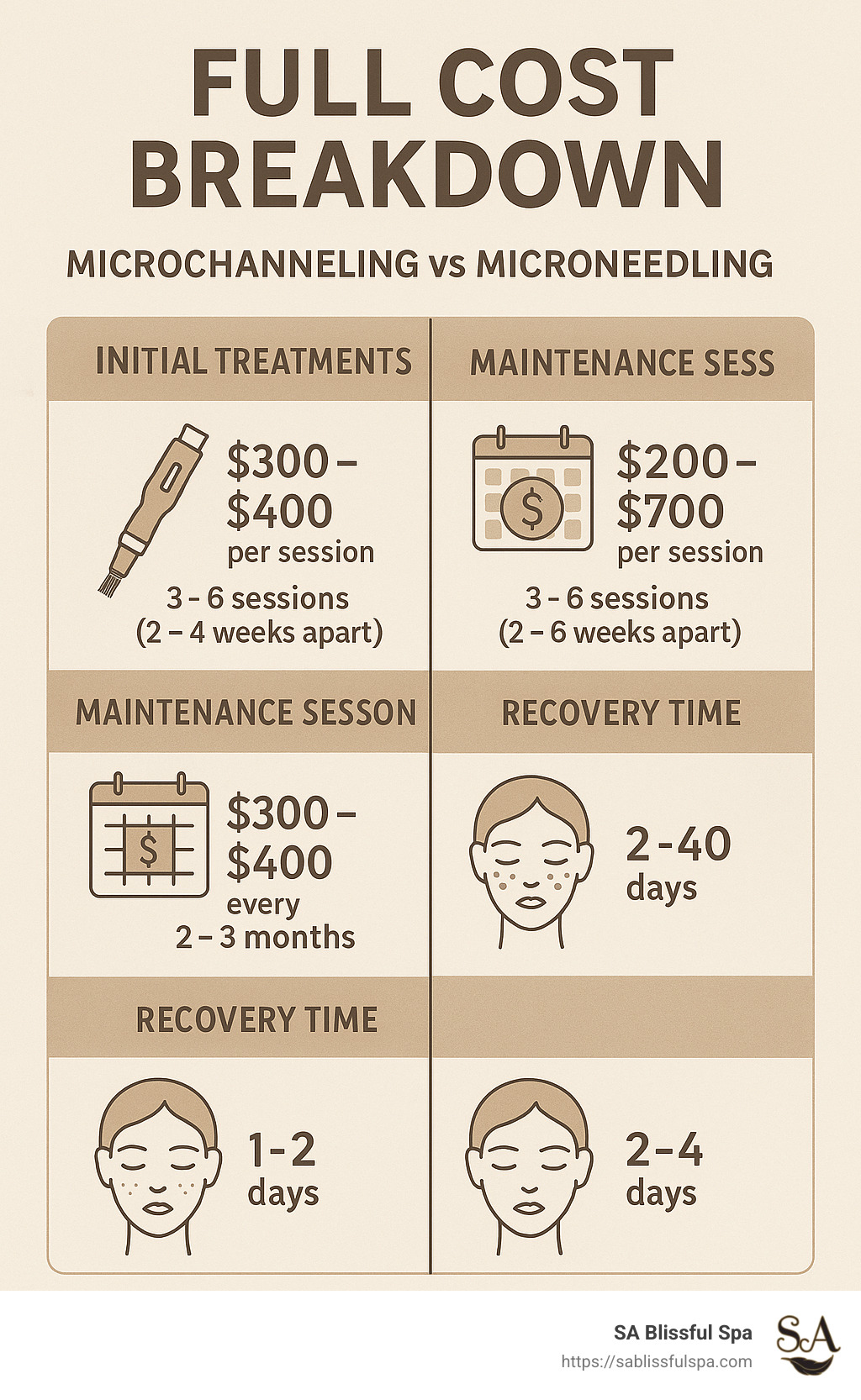
Across the United States, microchanneling sessions tend to run anywhere from about $250 up to $1,200 per treatment. Most typical face-and-neck sessions hover around the $300–$425 mark. With microneedling, you’ll often see slightly lower costs overall, ranging from about $100 to $700 per session, with an average facial treatment priced close to $300.
Of course, that’s a pretty big price range, right? So what’s driving that difference?
Several things influence these variations. For starters, your geographic location plays a big role. Treatments tend to cost more in major cities and metropolitan areas. For example, average microneedling treatments in New York City can go as high as around $1,328, while other smaller cities might offer the same service for less than $200.
Then there’s your provider’s expertise and qualifications. Treatments performed by highly trained specialists like doctors or experienced medical estheticians generally come at a higher price. When it comes to skincare treatments, you’re investing in the expertise and quality of care—so it’s often worth paying a bit extra to get the best results.
Next up is technology and device differences, another significant influence on microchanneling vs microneedling cost.
Microchanneling treatments often come with specialized technology, like the advanced ProCell Microchanneling system, which can boost your investment a bit. This high-end technology uses ultra-precise microchanneling tips and exclusive serums packed with growth factors and cytokines. These powerful ingredients help maximize your results, making that little extra cost worthwhile for many clients.
Another factor that matters is the size and area of treatment. A basic facial microchanneling session typically costs around $350, whereas treating both the face and neck might be closer to around $425. Want to extend that youthful glow to your chest area? Adding on larger body areas naturally increases the cost, typically around $100 more depending on the size.
Many providers, like SA Blissful Spa, offer package deals to help make costs more manageable. For example, purchasing a package of three facial treatments often saves around $160 or more compared to paying for individual sessions. This way, clients can enjoy the cumulative benefits of regular treatments while keeping their skincare goals budget-friendly.
Don’t forget about post-treatment care products either. Some microchanneling services bundle specialized take-home serums and healing kits into the overall treatment price. These kits typically range from about $48 to $80. While optional, these serums help speed up healing, boost collagen production, and extend your results, making them a worthwhile addition.
Microneedling expenses also vary quite a bit, and again, the specific equipment plays a significant role. For example, treatments using popular devices like SkinPen average around $630, while those using Dermapen typically cost about $380. More advanced treatments like RF (radiofrequency) microneedling jump significantly in price—averaging from $1,000 to $2,400 per session.
Your provider’s expertise also comes into play here. Choosing to have microneedling performed by a physician or registered nurse usually adds to the total cost. Licensed estheticians can often offer more affordable pricing, though many factors go into choosing whom you’re most comfortable with for your skincare treatments.
Optional add-on services can also influence microneedling costs. Adding improvements like platelet-rich plasma (PRP) therapy averages about $750 per session, while hyaluronic acid or vitamin C serums can tack on another $50 to $200. Numbing cream applications might be included or can sometimes incur an extra fee, depending on the provider.
Here at SA Blissful Spa, we know that cost is a big factor for our clients. We always offer clear and transparent pricing custom to your unique skincare goals. Whether you’re in Burlington, Arlington, Bedford, Belmont, or any surrounding communities, we’re here to help you find a solution that fits your needs, your budget, and your skin.
Have specific questions about microchanneling vs microneedling cost? Get in touch with us for a personalized consultation—we’re always happy to chat!

When clients ask about the microchanneling vs microneedling cost, it helps to understand the factors behind the pricing. At SA Blissful Spa, we believe in transparency, and knowing what you’re paying for makes a big difference in choosing the best skincare option for your needs.
There’s more than meets the eye when comparing these two popular treatments. Let’s explore what’s driving the differences in costs between microchanneling and microneedling.
One of the main reasons behind the price difference is the technology itself. Microchanneling devices, such as the ProCell system, tend to be more advanced and precise. These devices use very fine, wire-based filaments to create neat, uniform microchannels in the skin. This precision helps minimize tissue trauma and inflammation, meaning less downtime for you.
Because of the sophisticated engineering involved, microchanneling systems typically require more investment upfront. Providers must regularly replace sterile components and maintain a high level of device care. Additionally, these advanced systems often include proprietary serums specifically designed for improved effectiveness, further influencing the overall price.
On the other hand, microneedling devices range widely in complexity and cost. Some providers use simpler dermarollers, while others invest in advanced motorized pens, like SkinPen or Dermapen. Generally, these devices involve thicker needles compared to microchanneling instruments. Although they may have lower upfront costs and maintenance expenses, they still need careful handling and sterilization between treatments.
Additionally, because microchanneling technology is newer and more precise, it often requires extra training and certification for practitioners. This specialized training ensures you get the very best treatment possible, but it also means higher provider costs, which can impact the pricing you see.
Beyond technology, add-ons play a significant role in shaping the microchanneling vs microneedling cost landscape. At SA Blissful Spa, we always personalize treatments to your specific skin concerns and goals. Some clients benefit immensely from improvements like growth factor serums, PRP therapy, or exosome treatments, while others might not find them necessary.
Growth factor serums are a popular improvement, especially with microchanneling. These serums, often derived from stem cell technology, contain regenerative ingredients that boost collagen production and speed up the skin’s healing process. Depending on the type and quality, adding these potent serums can increase the price by around $50–$200 per session—but many clients find the dramatic improvements well worth the extra investment.
Another popular add-on is PRP (platelet-rich plasma). PRP involves drawing a small amount of your blood, processing it to concentrate healing platelets, and applying this enriched plasma during your treatment. PRP therapy typically adds about $250–$400 per session but can significantly improve results, particularly for scarring, fine lines, and overall skin rejuvenation.
For those seeking cutting-edge skincare solutions, exosome therapy is another advanced option. Exosomes, tiny vesicles that help communicate cellular repair signals, can boost skin regeneration and improve outcomes even further. This innovative treatment adds between $300–$600 to a session but can deliver truly impressive results that standard treatments alone may not provide.
Finally, specialized masks and take-home products are also factors to consider. Soothing collagen masks, LED light therapy sessions, or post-care product kits can add from $50 to $200 per treatment. These options not only improve immediate results but also help protect your investment by maintaining your skin’s health between visits.
At SA Blissful Spa, our mission is always to help you make informed skincare decisions. We’ll carefully walk you through your options during your initial consultation, keeping your goals and budget in mind. And remember, while add-ons can significantly boost results, they’re not always necessary for everyone—so rest easy knowing you’ll never feel pressured into purchasing something you don’t truly need.
To see what’s possible with microchanneling, check out some of our clients’ before and after results here.
When weighing the microchanneling vs microneedling cost, it’s helpful to think beyond the initial price tag. A single session price matters, but the real value comes into focus when you consider the total investment needed over time. After all, we’re talking about your skin here—it’s a long-term relationship!

Let’s break down how many sessions you might need to achieve that glowing, refreshd complexion—and keep it that way.
Although both treatments share the goal of smoother, healthier-looking skin, the number of sessions required to get there can differ quite a bit.
For microchanneling, fewer appointments are typically needed to achieve noticeable improvements. If you’re simply addressing early signs of aging or mild texture issues, you’ll often see results in just 1-2 treatments. For moderate concerns like deeper fine lines or uneven texture, expect around 3-5 sessions, while significant issues such as acne scars might require about 4-6 treatments. We usually space these treatments out about 4-6 weeks apart, giving your skin time to heal and build new collagen.
On the other hand, microneedling usually involves a slightly longer journey. General skin rejuvenation typically takes about 3-6 treatments, while deeper concerns like acne scarring or pronounced wrinkles can require up to 6-8 treatments. Similar to microchanneling, these sessions are spaced roughly every 4-6 weeks.
At first glance, microchanneling might seem pricier per session—typically around $350 compared to microneedling’s average of $300—but when you factor in the total number of sessions, the story changes a bit. For example, if you’re tackling moderate skin concerns:
See what just happened there? Even though microchanneling costs more per visit, you may actually save money overall by needing fewer sessions. That’s why it’s important to look at the bigger picture when talking about microchanneling vs microneedling cost.
So, you’ve completed your initial treatments—hooray! Now, it’s all about keeping your skin in tip-top shape. Maintenance treatments help sustain your beautiful results so you can continue glowing confidently.
For microchanneling, we typically recommend a touch-up session every 6-12 months. This generally means budgeting about $350-$700 per year, depending on whether you opt for one or two sessions annually.
In contrast, microneedling maintenance sessions are usually suggested more frequently—around every 3-6 months, meaning an annual investment of roughly $600-$1,200 per year.
Again, while individual sessions might seem less expensive with microneedling, you could end up investing more over time due to the increased frequency of treatments.
Beyond clinic visits, maintaining your results also involves consistent at-home skincare. This doesn’t have to break the bank, but a few targeted products can make all the difference. Post-treatment healing products typically range between $40-$100, daily sun protection (which is always a must!) runs about $25-$60, and collagen-supporting serums usually cost around $50-$150.
At SA Blissful Spa, our goal isn’t just to provide treatments—it’s to guide you in making smart, informed choices for your skin and your budget. We’ll help you find a personalized balance, recommending products and maintenance schedules that fit your lifestyle, goals, and wallet.
Bottom line? When considering microchanneling vs microneedling cost, look beyond the upfront session price. Think about how many sessions you’ll need, how often you’ll want to come back, and the long-term maintenance involved. Your skin—and your wallet—will thank you!
One of the most frequent questions clients ask us at SA Blissful Spa is: “Is the higher cost of microchanneling really worth it compared to microneedling?” While there’s no straightforward “yes” or “no,” understanding a few key factors can help you decide what’s best for your budget, lifestyle, and skin goals.
When you think about microchanneling vs microneedling cost, it’s important to factor in more than just the price per session. Your time and comfort make a big difference too.
With microchanneling, downtime is significantly shorter. Right after treatment, you might have redness and mild sensitivity, but these usually fade within about 90 minutes. Most clients happily return to their daily routines the same day. And makeup? You can usually apply it the very next day.
In contrast, microneedling typically involves a bit more downtime. Redness and mild inflammation can linger for about two days, meaning you might need to plan your social or work schedule accordingly. Makeup application usually has to wait at least 24 to 48 hours after treatment, and your skin may need up to four days to feel completely back to normal.
As our lead esthetician often jokes, “If you’re someone who doesn’t have time to hide out at home binge-watching your favorite show for a couple days (tempting as that may sound!), microchanneling may be your best bet.”
Comfort during the procedures is another key consideration. Most clients describe microchanneling as tolerable—like a gentle tickling or mild prickly feeling. On the other hand, microneedling can feel a bit more intense, although a numbing cream helps minimize discomfort.
All things considered, if comfort and minimal downtime are a priority for you, microchanneling offers real value—even if it costs a bit more per session.
When comparing the results you can expect, both treatments deliver impressive skin rejuvenation. But there are subtle differences worth noting.
Skin texture and tone improvement is significant with both treatments. However, microchanneling’s precision stamping produces more consistent, uniform results. Its controlled application means less risk of uneven texture or missed areas.
For fine lines and wrinkles, both techniques offer substantial improvement. Still, the advanced microchanneling technology combined with specialized growth factor serums typically accelerates the skin’s collagen response. You may notice smoother, youthful-looking skin sooner.
When it comes to tackling acne scars, microneedling sometimes has the edge for deeper scars since needles can reach slightly greater depths. Yet, microchanneling’s precise technique, coupled with potent growth factor serums, often yields fantastic results with less tissue trauma. This translates to less redness, irritation, and downtime.
If you’re dealing with hyperpigmentation or uneven skin tone, both treatments can help. But microchanneling’s reduced inflammation tends to lower the risk of post-inflammatory hyperpigmentation, making it especially beneficial if you have sensitive skin or a darker complexion.
As our senior esthetician at SA Blissful Spa always says, “Both treatments work wonders, but microchanneling often gives clients the best overall experience—especially if you prioritize comfort, convenience, and quicker recovery.”
In the end, determining whether the slightly higher cost of microchanneling is worth it comes down to your personal preferences, budget, and skin goals. If downtime and comfort matter a lot, microchanneling often justifies its price tag. But if cost is your top priority and you don’t mind a bit more downtime, microneedling still provides fantastic results.
For a more detailed discussion about which treatment suits you best, check out our dedicated page on whether microchanneling is better than microneedling, or better yet, schedule a personalized consultation at SA Blissful Spa—we’d love to help you find your ideal solution!
Here at SA Blissful Spa, clients naturally have plenty of questions before choosing between treatments—especially when it comes to microchanneling vs microneedling cost. To help you steer these decisions, we’ve answered some of the most common questions we hear.
Generally speaking, insurance doesn’t cover microchanneling or microneedling because they’re considered cosmetic treatments, not medical procedures. However, there are a few exceptions you might want to know about.
In rare cases, insurance may cover these treatments if they’re considered medically necessary—for instance, if a dermatologist prescribes them to treat severe scarring from surgery or trauma, or as part of a treatment plan for certain skin conditions.
But keep in mind, insurance coverage for these scenarios is pretty limited and varies widely between insurance providers and specific plans. Your best bet is to chat directly with your insurance provider before assuming any treatments will be covered.
Also, don’t forget about your FSA (Flexible Spending Account) or HSA (Health Savings Account)! Often, you can use these funds toward skincare treatments, making it a bit easier on your wallet. If you think your treatment might qualify for reimbursement, just ask us for a detailed receipt you can submit to your plan provider.
Ultimately though, most of our clients view microchanneling and microneedling as worthwhile investments in their skin health, confidence, and overall wellbeing. That’s why SA Blissful Spa offers flexible payment options and packages to help you comfortably fit these treatments into your budget.
We understand—there are plenty of at-home microneedling devices and dermarollers online that seem like tempting bargains. While these tools can range from about $15 to $140, they’re quite different from professional treatments in some very important ways.
At-home devices typically have shorter needles (around 0.25-0.5mm), limiting their ability to trigger substantial collagen growth. Professional treatments at SA Blissful Spa use medical-grade tools that safely penetrate deeper (0.5-2.5mm) to deliver more noticeable and lasting results.
Plus, when you do treatments at home, you miss out on expert guidance and sterile conditions, increasing your risk of infection, scarring, or skin irritation. Our trained estheticians know exactly how to customize each session, applying precise techniques and professional-grade serums custom specifically to your skin type and goals.
We like to say: at-home kits are kind of like baking your own bread. You can do it, but chances are it’ll never quite match what you’d get from a professional baker. (And your skin deserves freshly baked perfection!)
If you’re looking to save money while still getting professional treatments, consider spacing out your sessions a bit more or opting for packages—these can significantly reduce your overall costs. And of course, our team at SA Blissful Spa can recommend affordable at-home products and routines to keep your skin glowing between visits.
Ah, the million-dollar question (or at least the few-hundred-dollar question!). When deciding between microchanneling vs microneedling cost, it’s important to weigh your budget alongside your skincare goals and lifestyle considerations.
First, think about your specific skin concerns. If you’re mostly looking to maintain a smooth, youthful complexion with preventive care, both treatments may suit you just fine—so cost and comfort could be your deciding factors. But if your skin is sensitive, prone to redness, or easily irritated, microchanneling’s gentler and more precise approach might justify its slightly higher price tag.
Next, consider your schedule and downtime. Time is money, right? If your life is super busy, you might prefer microchanneling’s minimal downtime, typically just a few hours to a day. Microneedling can mean redness lasting around 1-2 days and a slightly longer recovery overall.
Finally, look at your long-term skincare goals. While microchanneling tends to cost more per session, many clients find they achieve desired results faster, needing fewer appointments. In contrast, microneedling sessions might cost a bit less initially but could require more frequent visits to achieve similar results.
The bottom line: The “cheapest” option isn’t always the best value if it takes longer to see results or if your skin requires extra recovery time. At SA Blissful Spa, we take the guesswork out of this decision. Our skincare specialists offer personalized consultations to help you map out the smartest strategy for your skin and your wallet.
Ready to learn more? Schedule your consultation at our Burlington, MA location today—we’d love to help you achieve beautiful skin that’s worth every penny.

When you’re comparing microchanneling vs microneedling cost, price is just one part of the story. Microchanneling typically runs a bit higher per session (averaging around $300–$425, compared to microneedling’s wider range of $100–$700). But there’s more to consider than just the sticker price.
The slightly higher cost of microchanneling reflects its advanced technology and careful precision. With its specialized stamping motion and consistent, controlled application, microchanneling may offer fewer sessions overall and a quicker recovery time—important factors that can positively affect your overall experience.
Think of it this way: Would you prefer fewer, more comfortable sessions with less downtime, or would you rather opt for potentially lower-cost individual treatments, even if you might need more sessions and longer recovery? Each approach has its merits, and the right choice depends entirely on your skin goals, lifestyle, and budget.
At SA Blissful Spa in Burlington, MA, we see skincare as an investment in your confidence and well-being—definitely not just another expense. Both microchanneling and microneedling offer excellent results for common skin concerns like fine lines, wrinkles, acne scars, uneven texture, and hyperpigmentation. However, microchanneling often delivers comparable or even superior results with less discomfort and downtime, making it ideally suited for sensitive skin or busy schedules.
Remember these key points when weighing microchanneling vs microneedling cost:
At SA Blissful Spa, we understand how confusing it can be to choose the best treatment for your skin goals and budget—that’s exactly why we always start with a personalized consultation. We’ll sit down together to evaluate your skin, discuss your objectives, and create a customized plan to deliver the most value for your investment.
Whether you ultimately choose microchanneling, microneedling, or another skin rejuvenation approach, our experienced team is here to guide you every step of the way.
Want to explore your options or schedule your personalized consultation? Visit our microchanneling service page today. We proudly serve clients throughout Burlington, MA, and nearby communities including Arlington, Bedford, Belmont, Billerica, and beyond.
After all, the true value of any skincare treatment isn’t just about how much it costs—it’s about helping you achieve radiant, healthy, beautiful skin that makes you feel amazing.


Book your first appointment online and enjoy 15% off your first service (one-time offer).
Use code NEWCLIENT15